
Finance and accounting careers are growing fast across the world. Many students now want a course that gives both a degree and a global qualification. That is why BBA with ACCA has become a popular choice among commerce students.
This guide explains the syllabus, exemptions, and duration of the program in concise terms so you can decide if it is the right path for you.
What Is BBA with ACCA?
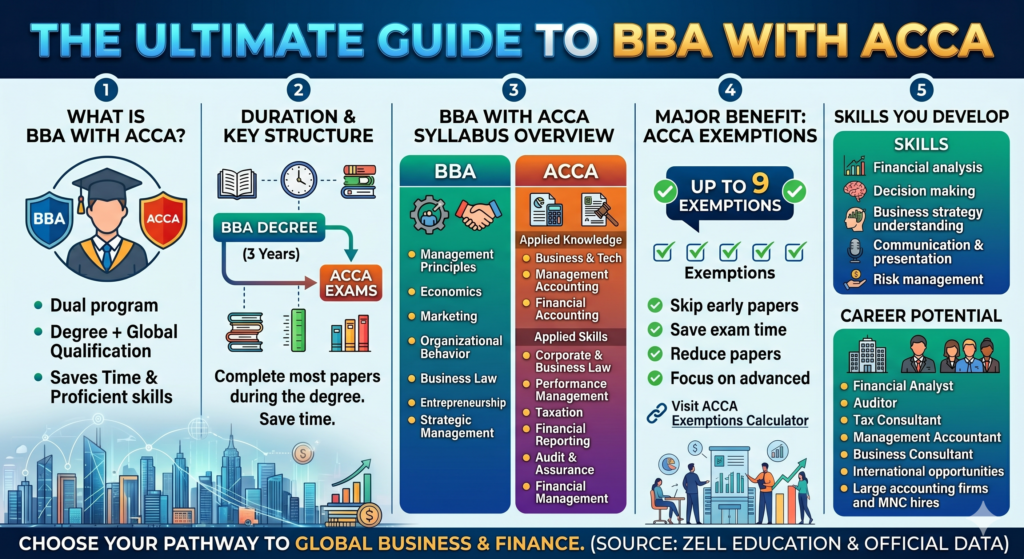
BBA with ACCA is a dual course, combining a Bachelor of Business Administration degree along with an ACCA program. ACCA is the abbreviated form of the Association of Chartered Certified Accountants, which is a worldwide accounting organisation located in the United Kingdom.
This means instead of studying these two programs individually, the student will study both programs together. This not only saves time but also makes the student proficient in business administration, finance, and accounting.
This course will prove beneficial for those students who wish to enter into multinational corporations, consultancy firms, and financial organisations, while also getting a glimpse of what ACCA is?
Duration of the Program
The duration of BBA with ACCA is usually three years, which is the same as a regular BBA degree. During these three years, students study business subjects along with ACCA exam topics.
However, finishing the entire ACCA qualification may take considerably longer. This is because ACCA has various exam levels that students must clear.
In most integrated programs:
- The BBA degree takes 3 years
- ACCA exams are completed during or shortly after the degree
Many students finish most ACCA papers while studying for their degree, which saves time compared to doing both separately.
BBA with ACCA Syllabus Overview
The syllabus of BBA with ACCA is designed to cover both business management and professional accounting topics. The program usually mixes university subjects with ACCA exam preparation.
BBA Subjects
These subjects focus on business and management basics. Common topics consist of:
- Principles of Management
- Business Economics
- Marketing Management
- Organizational Behavior
- Business Law
- Entrepreneurship
- Strategic Management
These subjects help students understand how companies operate and make business decisions.
ACCA Subjects
ACCA has three primary levels, and many BBA with ACCA programs pair their teaching with these levels.
Applied Knowledge Level
- Business and Technology
- Management Accounting
- Financial Accounting
Applied Skills Level
- Corporate and Business Law
- Performance Management
- Taxation
- Financial Reporting
- Audit and Assurance
- Financial Management
These courses provide the students with knowledge regarding managing finances, business law, and business analysis.
ACCA Exemptions For BBA
One major benefit of a BBA with ACCA is the exemptions offered by ACCA. Exemptions mean students do not need to appear for certain ACCA exams because their university subjects already cover similar topics.
In many integrated programs, students can receive up to nine exemptions. This allows them to skip the early ACCA papers and move directly to the advanced level. However, the number of exemptions depends on the college and the course structure.
Students should always check the official ACCA exemption list before enrolling. Exemptions help students:
- Save exam time
- Reduce the number of papers to attempt
- Focus on advanced professional subjects
To check the available ACCA exemptions for BBA, visit Exemptions Calculator by ACCA Global
Skills You Develop
An ACCA BBA programme focuses on both technical and practical skills. Technical and practical skills will assist students in achieving success in finance and business positions.
Some important skills acquired from this course include:
- Financial analysis
- Decision making
- Business strategy understanding
- Communication and presentation
- Risk management
These abilities are valuable in many industries, including banking, consulting, and corporate finance.
Career Potential
Graduates with BBA with ACCA have great job prospects in accounting and finance. Firms seek out candidates with insights into business management and financial accounting. Common career roles include:
- Financial analyst
- Auditor
- Tax consultant
- Management accountant
- Business consultant
Large accounting firms and multinational companies frequently hire ACCA-qualified professionals. With experience, graduates can also move into leadership positions in finance departments. Many professionals also work internationally because ACCA is recognised in many countries.
Conclusion
Opting for BBA with ACCA is one of the best decisions that a student could make to have an international career in the field of accounting. This combination of management education and professional knowledge in accounting would give you an upper hand.
When deciding on which university you should join, it is important to go through the syllabus and the exemptions to see how helpful ACCA course can be for your future career.
FAQs on BBA with ACCA
Can I take BBA with ACCA?
Yes, you can take a Bachelor of Business Administration (BBA) alongside the Association of Chartered Certified Accountants (ACCA) qualification.
Which is the best combination with ACCA?
The best combinations to go along with ACCA depend upon career preferences; while ACCA & CFA work out well for investment banking, ACCA & MBA would be perfect for management careers.
What are the advantages of combining ACCA with BBA?
Benefits are global recognition in over 180 countries, accelerated progression, and exemptions from several ACCA exams, saving both time and costs.