

The selection of an ACCA MBA course in 2026 is gradually gaining popularity among students who wish to gain not only professional accountant skills but also a management degree. Such a combination involves both financial knowledge and business skills that are highly valued in the current market.
ACCA MBA: Quick Overview
- Duration: 1.5 to 3 years
- Cost: 3.5 to 30 lakhs
- Exemptions: Up to 9 exemptions
- Syllabus: Business leadership and financial expertise
- Career Scope: Roles, such as CFO or Finance Director (banking, consulting, and MNCs)
- Recognition: Universal portability (over 180 countries)
What Is ACCA and Why It Matters?
It would be good to understand what ACCA is prior to taking this course. ACCA stands for the Association of Chartered Certified Accountants. It is an international body that provides the ACCA accreditation, which revolves around accounting, audit, taxation and finance.
Why Choose ACCA MBA?
An ACCA MBA gives you the edge by combining a world-respected accountancy qualification with advanced business management education. This dual pathway helps students develop strong analytical, leadership and decision making skills needed in modern organisations.
Major Benefits
- Acquires knowledge in accounting, finance and business strategy at the same time. This enables the professional to perform well in both technical and managerial positions.
- Offers international career opportunities: Employers are likely to favour candidates with a professional certification and a management degree.
- Allows flexibility for students to complete both qualifications in a systematic and timely manner.
This combination provides students with a strong foundation for leadership in the finance and business fields.
ACCA MBA Syllabus Overview
An ACCA MBA syllabus will include core accounting concepts as well as advanced management topics. It provides a good overall picture of finance, strategy and operations.
ACCA Subjects
- Applied Knowledge Level (Business and Technology, Management Accounting, Financial Accounting)
- Applied Skills Level (Corporate and Business Law, Performance Management, Taxation, Financial Reporting, Audit)
- Strategic Professional Level (Strategic Business Leader, Strategic Business Reporting, optional papers)
MBA Subjects
- Marketing Management
- Financial Management
- Human Resource Management
- Operations and Strategy
This integrated syllabus ensures that students gain both technical depth and managerial perspective.
Exemptions in ACCA MBA
One of the best benefits of pursuing an ACCA MBA is the exemptions available. These exemptions can help reduce the time it takes to complete the qualification. You get exemptions if you have previous education and qualifications.
Common Exemptions Include
- B.Com graduates may be exempted for 4-5 papers depending upon the university syllabus.
- ACCA papers carry exemptions for CA or CMA students as they have a common syllabus and prior knowledge.
- MBA students specialising in finance may also qualify for certain subject exemptions.
These exemptions allow students to fast-track their journey and reduce the overall study load.
ACCA vs MBA Components
The above table illustrates how these two certifications complement each other.
| Feature | ACCA Component | MBA Component |
| Focus | Accounting and Finance | Business and Management |
| Structure | 13 Papers (with exemptions) | Semester-based curriculum |
| Skill Development | Technical and analytical skills | Leadership and strategic skills |
| Career Roles | Accountant, Auditor | Manager, Consultant |
Career Benefits of ACCA MBA
An ACCA MBA opens up many job opportunities because it provides individuals with skills that are in high demand in various fields. People with such qualifications are usually preferred where there is a need for expert skills and knowledge of business.
Career Advantages
- Availability of well-paid jobs in MNCs, consultancy companies, and financial organisations in various sectors.
- Rapid career growth since the person combines professional certification with management studies.
- Working in the international market where one can work in finance and management.
Such qualifications make an individual unique in a very competitive job market.
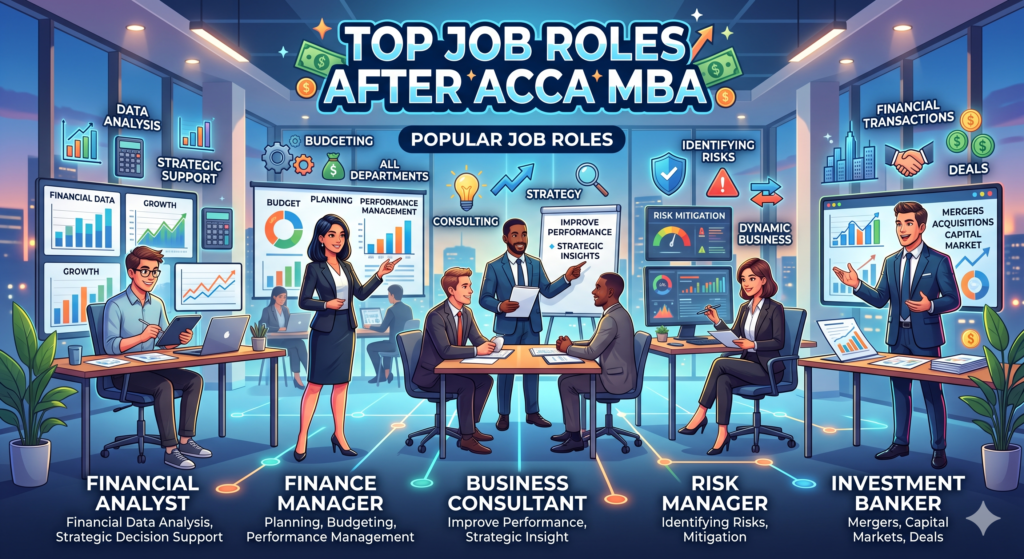
Top Job Roles After ACCA MBA
Financial Analyst, responsible for financial data analysis and strategic decision support in a corporate setting.
Popular Job Roles
- Finance Manager, responsible for financial planning, budgeting and performance management for all departments.
- Business Consultant, assisting businesses to improve performance via financial and strategic insight.
- Risk Manager, identifying and mitigating financial risks in a dynamic business environment.
- Investment banker; engaged in financial transactions, mergers and capital market activities.
Both roles offer a competitive salary package and good growth opportunities.
Conclusion
An ACCA MBA is a potent combination that offers technical skill and business acumen. With its well-designed syllabus, exemptions, and career advantages, it is one of the best decisions for students who wish to take up executive positions in finance and management.
For those students who wish to pursue a globally oriented future-proof career, taking an ACCA MBA can be a good decision in 2026.
FAQs on ACCA MBA
Can we do ACCA with MBA?
Yes, you can pursue an MBA and ACCA together.
How long is the ACCA MBA program?
An ACCA MBA program typically takes between 18 and 36 months to complete.
Is MBA after ACCA worth it?
Yes, it is a powerful combination for accelerating career growth, offering higher salary potential.