
The importance of studying portfolio management CFA Level 1 cannot be understated for those aspiring to take the CFA examination in 2026 because it provides the basics of investing and managing one’s finances. This subject will familiarise candidates with the basics of portfolio management.
Quick Guide on Portfolio Management
- Weightage: 8% to 12% in level I CFA exam
- Questions: 14 to 21 questions
- Question Pattern: Multiple choice, three options, fill-in-the-blanks
- Level of Difficulty: Medium
- Time Required for Preparation: 20 to 40 hours
- Key Areas Covered: Portfolio management, risk vs return, and asset allocation
Summary of Portfolio Management in CFA Level 1
The topic of Portfolio Management CFA Level 1 focuses on basic principles of managing investments to achieve specific financial objectives. It will also explain how to optimise risk and returns by matching investments to investors’ objectives and limitations.
Learning Outcomes
- Understand diversification and its impact on lowering the overall risk in an investment portfolio.
- Understanding the behaviour and impact on performance of the various asset classes in different market situations.
- Investor objectives and constraints like risk tolerance, investment horizon, and liquidity requirements.
This topic is crucial because it lays down an excellent foundation for more complex topics on portfolio management that you will study in higher CFA levels.
Portfolio Management Weightage in CFA Level 1 Exam 2026
While portfolio management is not given much weightage in the CFA Level 1 exam, it holds considerable importance in obtaining high marks, provided that you have clarity regarding the concepts.
Exam Weightage
- Ranges from 5% to 8% of the overall exam
- An estimated 8–12 questions can be asked from this topic
Though the weightage might appear to be less than that of other topics, the questions will mostly be based on concepts.
Fundamental Concepts in Portfolio Management
To master Portfolio Management CFA Level 1, candidates must focus on core concepts that form the backbone of investment management.
Important Topics
- Investment performance can be measured in terms of the risk and return of a portfolio (expected return, variance, and standard deviation).
- Diversification explains how the combination of different assets reduces unsystematic risk in a portfolio.
- Modern Portfolio Theory (MPT) is concerned with the efficient frontier and optimal portfolio selection.
- Capital Market Line (CML) showing the risk-return trade-off for efficient portfolios.
- Investor’s preferences, such as risk aversion and utility functions.
These concepts are interconnected and frequently tested in the exam.
Important Concepts Breakdown
This table provides a quick revision guide for important topics within the syllabus.
| Concept | Description | Importance Level |
| Diversification | Reduces risk by spreading investments | High |
| Risk and Return | Measures performance of investments | High |
| Efficient Frontier | Optimal portfolio combinations | Medium |
| Capital Market Line | Risk-return relationship | Medium |
| Investor Constraints | Defines investment strategy | High |
Preparation Strategy for Portfolio Management
For preparing for CFA Level 1 portfolio management, it is necessary to have a proper understanding of the topic and practise questions regularly.
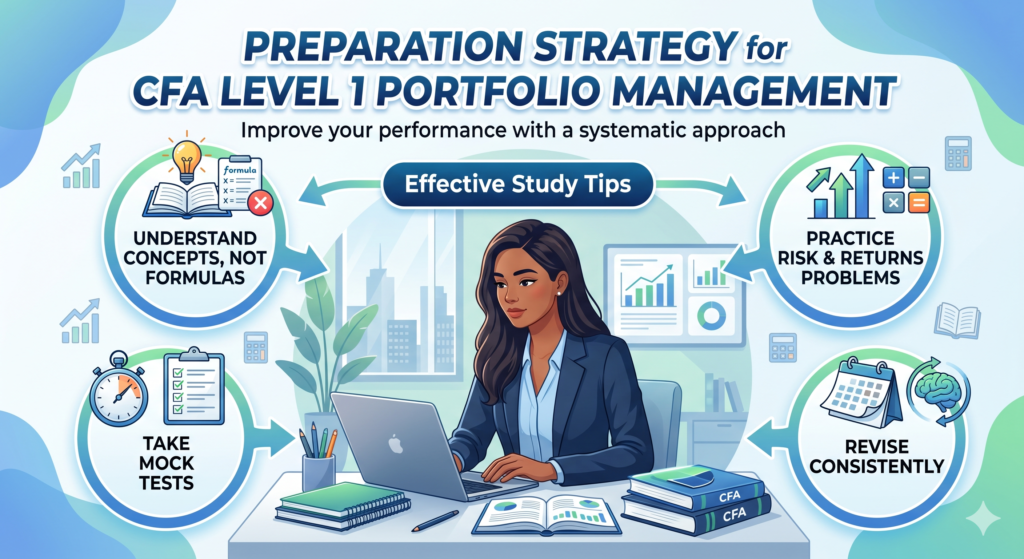
Effective Study Tips:
- Since most of the questions are not related to formulae and calculations, there should be an emphasis on understanding instead of memorising formulas.
- Practice numerical problems based on risk and returns.
- Mock tests will aid you in discovering your strengths and weaknesses, and help manage your time efficiently in the exam.
- Revise formulas and concepts consistently
However, you can improve your performance in this section with a systematic approach.
Common Mistakes to Avoid
When studying portfolio management CFA Level 1, candidates make mistakes that can affect their overall score.
Mistakes to Avoid:
- Skipping the basics, like diversification and only focusing on the advanced stuff.
- Not doing enough numerical questions on portfolio calculations”.
- Underestimating the importance of this section because of low weightage.
Staying away from these mistakes will help you get better scores and also build a solid base for the upcoming levels.
Why This Topic Matters
Portfolio management at CFA Level 1 is very crucial because it introduces candidates to practical investing techniques employed by financial practitioners in their daily work. It is very beneficial to learn how investment portfolios are constructed in order to achieve certain financial objectives.
It will prove very useful both in the exam and in a future career in asset/wealth management or investment analysis.
Conclusion
Before you begin your CFA journey, it is important to know what CFA is. The CFA program is a globally recognised certification in investment management, financial analysis and ethics in finance.
Portfolio Management CFA Level 1 is an important part of CFA curriculum that provides critical insights on investment strategies and risk reduction. With good preparation and understanding of important topics, candidates can score well in this section.
FAQs on Portfolio Management
Is portfolio management tough in CFA level 1?
Portfolio management in CFA Level 1 is generally considered manageable and introductory, not one of the toughest topics.
Is CFA worth it for portfolio management?
Yes, the CFA charter is generally considered worth it for a career in portfolio management.
What is the salary of a CFA Level 1 portfolio manager?
A Portfolio Manager in India who is a CFA Level 1 candidate can expect a salary range of about Rs.6,00,000 to Rs.10,00,000