

What FRM is will be a vital thing to know for those who want to pursue careers in financial risk management, banks, investments, and financial consultancy. The certification of FRM is internationally acknowledged, and it deals with the identification, assessment, and management of financial risks in different markets.
What is FRM: Brief Summary
- Full Form: Financial Risk Manager
- Type: Professional Certification
- Governing Body: Global Association of Risk Professionals (GARP)
- Eligibility: Grade 12 Cleared
- Structure: 2 Sections (Part 1 and Part 2)
- Duration: 1 to 1.5 years
- Focus: Managing financial risks across Markets, Credit, and Operational Functions
- Career Roles: Market Risk Analyst, Credit Risk Manager, Operational Risk Consultant, or Chief Risk Officer
Due to increasing complexity within financial systems, there is a need for specialists in the management of uncertainties and decision-making about risks. The increasing demand for the certificate is very lucrative for financial specialists around the world.
Understanding the FRM Certification
To answer ‘What is FRM?‘, it is essential to know that the Financial Risk Manager qualification is offered by the Global Association of Risk Professionals (GARP). The certification focuses on practical risk management concepts used in banking, investment management, and corporate finance.
Coverage Features
- Techniques used in financial institutions around the world to manage market risk, credit risk and operational risk.
- Quantitative analysis and valuation models to enable organisations to measure and control financial exposures.
- Basics of investment management, treasury management, and the financial regulation affecting global markets.
The qualification combines theory and practice, making it very relevant to careers in finance.
Structure of the FRM Programme
The FRM credential has two tiers of exams, each intended to assess basic and advanced risk management knowledge.
Levels of FRM Exam
- Part I – Quantitative Analysis, Financial Markets, Valuation Methods and the Principles of Risk Management
- Part 2 – Focus on application of risk management concepts, investment strategies and current financial issues.
To officially earn the certification, candidates must pass both levels and meet the relevant work experience requirements.
Overview of FRM Course
This structure endows candidates with sound technical and analytical skills in the management of financial risks.
| Component | Details |
| Number of Exam Levels | Two Parts |
| Main Focus | Financial Risk Management |
| Conducting Body | GARP |
| Exam Frequency | Multiple windows annually |
| Key Topics | Risk, valuation, analytics, investments |
Eligibility and Difficulty Level
When exploring what FRM is, candidates often want to understand eligibility requirements and exam difficulty before starting preparation.
Eligibility Highlights
- No mandatory educational qualification is required to register for the examinations.
- Students, graduates, and working professionals from finance or non-finance backgrounds can apply.
- Relevant work experience is required later to receive the official designation.
These exams are considered tough as they focus on practical understanding, analytical thinking and application-based problem-solving skills.
Career Prospects Post FRM
The FRM certification can open many doors for a career in banking, consulting, investment management and financial services industry.
Popular Career Roles
- Risk Analyst
Responsible for identifying and analysing financial and operational risks within organisations.
Salary: ₹8 LPA to ₹14 LPA
- Credit Risk Manager
Evaluating lending risks and ensuring financial stability for institutions and businesses.
Salary: ₹10 LPA to ₹20 LPA
- Investment Risk Analyst
Monitoring portfolio performance and managing market-related financial risks effectively.
Salary: ₹10 LPA to ₹15 LPA
- Treasury Manager
Overseeing liquidity management and financial resource planning within organisations.
Salary: ₹8 LPA to ₹15 LPA
- Financial Consultant
Helping businesses improve financial strategies and manage uncertainty successfully.
Salary: ₹5.5 LPA to ₹7.5 LPA
Source: Naukri/FRM Jobs
These roles offer strong career progression and opportunities for international professional exposure.
Benefits of Pursuing FRM
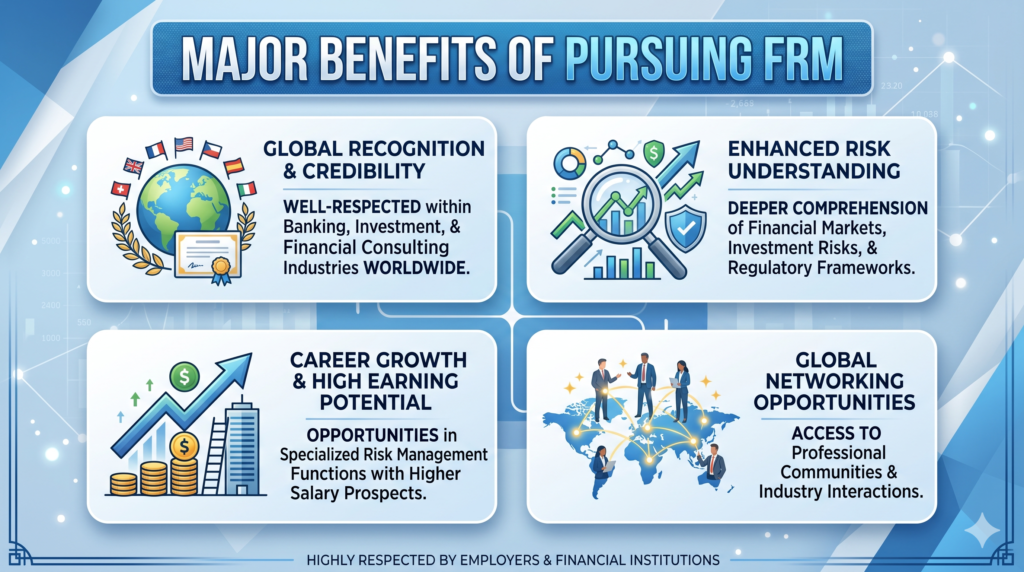
Pursuing the FRM certification provides several advantages for professionals looking to specialise in financial risk and strategic finance management.
Major Benefits
- Global recognition and credibility within banking, investment, and financial consulting industries worldwide.
- Better understanding of financial markets, investment risks, and regulatory frameworks affecting organisations.
- Higher earning potential and career growth opportunities in specialised risk management functions.
- Opportunity for global networking through professional communities and industry interactions.
These benefits make the qualification highly respected among employers and financial institutions.
Technical Skills Acquired by FRM Certification
FRM certification enables candidates to acquire practical and technical skills that would enable them to deal with complex financial risks.
Key Technical Skills
- Analytical and quantitative skills needed to assess the market and financial risks.
- Decision-making skills applied during risk analysis and financial planning.
- Problem-solving skills for dealing with uncertainties in the financial and economic markets.
- Reporting skills for communicating financial information to management.
These competencies kind of boost employability, and they help with long term professional growth in finance industry roles.
Why FRM Remains Relevant in 2026
As financial markets change at a fast pace, organisations are ever more in need of professionals who understand modern risk management techniques and regulatory expectations. Grasping what the FRM is helps the candidates to appreciate why the credential is still so valuable in global finance.
Market volatility, investment risk, cybersecurity and financial regulations are fuelling demand for qualified risk management professionals.
Conclusion
So, the answer to ‘What is FRM?’ should be much clearer by now for students and professionals who are looking for a career in 2026. The qualification provides specialist skills, excellent career opportunities and world recognition in the finance industry.
As the need for skilled financial risk professionals increases around the world, the FRM certification continues to provide excellent career growth, industry credibility and long-term professional value.
FAQs on ‘What is FRM?’
What is FRM?
FRM is a certification in financial risk management offered globally.
What does FRM do?
FRM professionals identify, analyse, and manage financial risks in organisations.
Is FRM better than CFA?
FRM and CFA serve different career paths; neither is universally better.