

Is there a chance that adding an additional qualification can add up to 40% to your income? Today many Indian finance students wonder about this. The answer usually leads to one particular combo, namely MBA with CFA.
In 2026, companies will need employees who can think strategically and analyse finances. This is why MBA CFA salary in India remains above the average for fresh graduates.
What Is CFA and Why It Matters?
Before we talk about salaries, it is important to understand the basics. If you are new to this field, you may want to read more about what is CFA and how it builds strong finance skills.
The CFA program focuses on investment analysis, portfolio management, and financial decision-making. It is known for its tough exams and global value. When you combine this with an MBA, you get both management knowledge and technical expertise. This mix is rare and valuable.
Average MBA CFA Salary in India (2026)
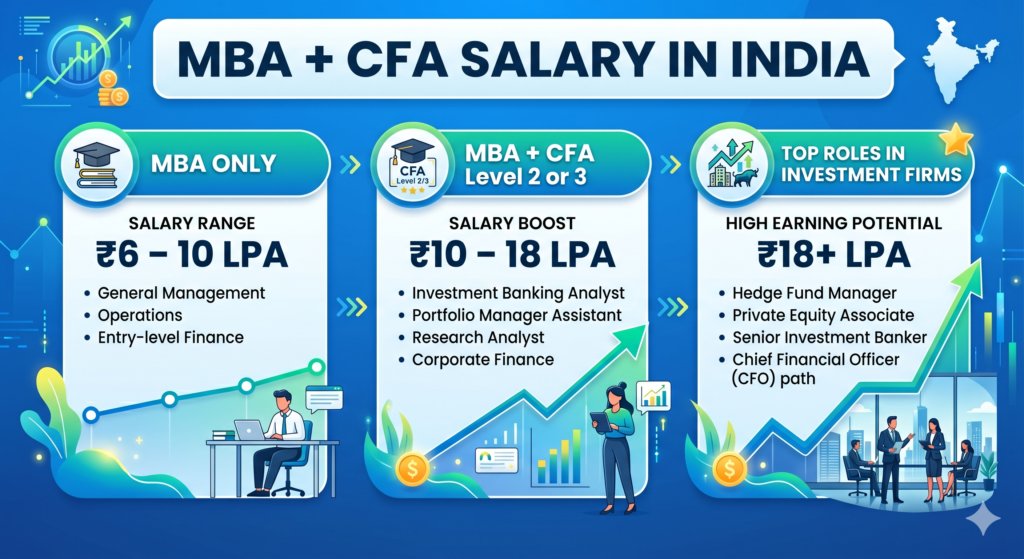
The MBA CFA salary for freshers in India is much better than most finance jobs. The average pay for an ordinary MBA graduate would be roughly ₹6-10 LPA. With CFA, however, the initial salary might get boosted.
Here’s a quick comparison:
- MBA only: ₹6–10 LPA
- MBA + CFA Level 2 or 3: ₹10–18 LPA
- Top roles in investment firms: ₹18+ LPA
Source – Indeed
This is an example of how the MBA CFA salary in India could potentially be increased from the very beginning. A lot of organisations are ready to offer higher salaries due to the fact that such applicants require less training.
Why Do Dual-Qualified Freshers Earn More?
There are clear reasons why the MBA CFA salary in India is higher for dual-qualified candidates.
- First, they bring two skill sets together. An MBA teaches business strategy, leadership, and management. CFA adds strong financial analysis skills.
- Second, these candidates are job-ready. They understand real-world finance concepts like valuation, risk, and investments.
- Third, fewer people have both qualifications. This creates a supply gap, which pushes salaries higher.
Companies prefer hiring one skilled person instead of training two separate employees. This is why the MBA CFA salary in India often reflects a 30–40% premium.
Top Job Roles After MBA + CFA
With both qualifications, you can apply for high-value roles in finance. Some common job options include:
- Investment Banking Analyst
- Equity Research Analyst
- Portfolio Manager
- Financial Analyst
- Risk Analyst
These roles offer strong learning and fast salary growth. Many of them are linked to global markets, which increases earning potential. In such roles, the MBA CFA salary in India can rise quickly within just a few years of experience.
Industries That Pay Higher Salaries
All industries do not pay the same amount. Certain industries provide better compensation packages to those holding dual qualifications.
The top paying industries are:
- Investment banks
- Asset management firms
- Consulting firms
- Private equity firms
- Hedge funds
Such industries handle significant monetary decisions. These require individuals capable of data analysis and prudent investment decisions. This factor influences the MBA CFA salary in India. It is higher compared to regular finance-related jobs.
Skills That Increase Your Salary
Even with both qualifications, your salary depends on your skills. Employers look for practical abilities, not just degrees.
Important skills include:
- Financial modeling
- Data analysis
- Communication skills
- Problem-solving
- Market understanding
These candidates usually receive better offers for themselves. This is yet another reason why the MBA CFA salary in India differs from one individual to another.
Is It Worth Doing MBA with CFA?
It will depend on your personal career objectives. If your objective is to secure high-level finance positions, this program can be quite beneficial for you. It takes time, energy, and concentration to pursue both programs simultaneously.
It may be difficult to balance the two programs due to the rigorous nature of CFA exams. However, the future benefits are well worth the hard work.
Final Thoughts
The salary for an MBA-CFA professional in India in 2026 undoubtedly highlights that being a dual-qualified fresher is highly advantageous. Employers tend to seek individuals who can work as managers but have knowledge of the financial sector as well.
If you are genuinely interested in making it big in the finance industry, CFA course will definitely help you immensely. You just need to tread cautiously along the way.
FAQs on MBA CFA Salary in India
What is the salary of CFA with MBA?
The salary of professionals having both the CFA and MBA degrees in India is Rs 15-25 LPA as a fresher and goes up to Rs 40-60 LPA or above after 5-10 years of experience.
Who earns more, CFA or MBA in India?
Professionals who have completed both the programs have the same average salary in India, that is, around 15-20 LPA.
Which is harder, CFA or MBA?
The CFA is generally considered academically and technically harder due to its rigorous, self-study curriculum and low pass rates.