

It becomes extremely important for an individual aspiring to become a Financial Risk Manager in 2026 to know about the FRM subjects. The course consists of two levels, which deal with various aspects of risk management, finance, and analysis. This study guide provides information on the syllabus, weightage, and important changes made to it.
Overview of FRM Subjects
The FRM subjects are split into two levels of examination – Part 1 and Part 2. The various aspects of financial risk management are discussed at each of the levels from the basic level to the advanced level.
Key Highlights
- Two exam levels: Part 1 and Part 2
- Focus on real-world financial risk scenarios
- Emphasis on analytical and practical knowledge
The systematic approach ensures that candidates acquire both theoretical knowledge and practical skills.
FRM Part 1 Subjects and Weightage
Part 1 of the FRM examination tests your basic knowledge regarding finance and risk management. The topics in the FRM subject include all fundamental concepts.
FRM Part 1 Subjects
- Foundations of Risk Management – 20%
- Quantitative Analysis – 20%
- Financial Markets and Products – 30%
- Valuation and Risk Models – 30%
What You Will Learn
- Basic risk concepts and frameworks
- Statistical methods and probability
- Financial instruments like derivatives
- Risk measurement models
This level is more concept-driven and requires a strong grasp of formulas and calculations.
FRM Part 2 Subjects and Weightage
Part 2 focuses on the practical application of concepts learned in Part 1. The FRM Subjects at this stage are more advanced and industry-oriented.
FRM Part 2 Subjects
- Market Risk Measurement and Management – 20%
- Credit Risk Measurement and Management – 20%
- Operational Risk and Resiliency – 20%
- Liquidity and Treasury Risk Measurement – 15%
- Risk Management and Investment Management – 15%
- Current Issues in Financial Markets – 10%
What You Will Learn
- Advanced risk management techniques
- Real-world financial case studies
- Risk in banking, investment, and corporate sectors
Part 2 is more practical and requires application-based learning rather than rote memorisation.
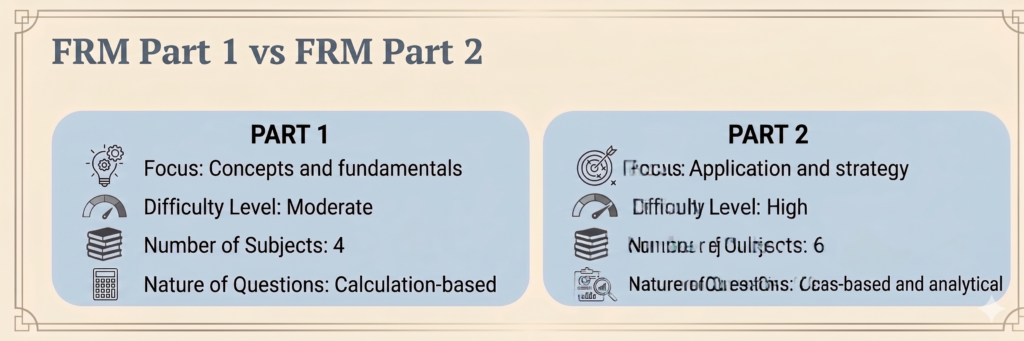
Comparison Table: Part 1 vs Part 2
This comparison will allow you to know how the exam moves from its basics to decision-making.
| Feature | Part 1 | Part 2 |
| Focus | Concepts and fundamentals | Application and strategy |
| Difficulty Level | Moderate | High |
| Number of Subjects | 4 | 6 |
| Nature of Questions | Calculation-based | Case-based and analytical |
Top Changes in FRM Subjects 2026
FRM subjects are revised continuously to keep pace with industry developments. In the year 2026, certain significant updates are anticipated.
Main Changes:
- Greater emphasis on risk technologies and analytics
- Greater focus on contemporary finance problems
- Coverage of subjects pertaining to environmental, social, and governance (ESG)
- Real-world case study applications
These changes ensure that candidates are well-prepared for modern financial challenges.
Preparation Tips for FRM Subjects
In order to succeed in studying the FRM subjects, a proper strategy must be put into place. This will help increase your chances of succeeding in passing the exam.
FRM Study Strategies
- Do not emphasise memory work but understand the concepts
- Practise numerical questions
- Take periodic tests to find your weaknesses
- Spend more time on high-weight topics
Why Understanding the Syllabus Matters
An accurate understanding of the FRM syllabus enables you to give preference to important subjects in relation to their weightage and difficulty. Moreover, it assists you in planning your study schedule and reduces your stress in the process.
Understanding the subject to be studied and the time to be spent on each subject can help you pass both sections of the FRM in less attempts.
Conclusion
FRM subjects in 2026 have been formulated to help you gain both theoretical knowledge and practical expertise needed in the financial sector. Since they provide an excellent combination of basic and specialised knowledge, the certification program will prepare you for a career in risk management.
It is essential to first find out what is FRM before beginning your preparation. The Financial Risk Manager certification deals with recognising, analysing, and mitigating financial risks.
FAQs on FRM Subjects
How many subjects are there in FRM?
The FRM (Financial Risk Manager) exam consists of two parts, totalling 10 distinct subjects focused on risk management.
What are the subjects in FRM?
According to the FRM syllabus for the year 2026, the subjects are categorised into two sections, covering fundamental tools and application in risk management respectively.
Can I do FRM without maths?
Yes, one can pass the FRM examination; however, basic statistical knowledge and probability calculations will always prove helpful along with a financial calculator.