

Understanding What is CPA is important for students and finance professionals planning to build a global career in accounting, auditing, taxation and financial management. The Certified Public Accountant license is one of the most highly respected professional credentials around the globe and is highly valued by multinational companies and financial institutions.
What is CPA: Brief Summary
- Full Form: Certified Public Accountant
- Type: Professional Licensure
- Issued By: Individual State Boards of Accountancy in the United States
- Governing Body: AICPA
- Structure: 4 Sections (3 Core + 1 Discipline)
- Duration: 1 to 1.5 years
- Focus: Auditing, Accounting, Tax, and Business Analysis
- Eligibility: Bachelor’s degree (120-150 Credits)
- Career Roles: Audit Partner, Financial Controller, Tax Director, and Chief Financial Officer (CFO)
Understanding the US CPA License
To answer What is CPA, it is essential to know that the license is issued by the United States Board of Accountancy and is recognised globally for expertise in accounting and finance. Holders of this certification are viewed as being proficient in audit, tax, compliance, and financial reporting functions.
Main Areas Covered
- Financial accounting and reporting standards in global business environments and multinational corporations.
- Auditing standards and compliance processes to ensure integrity and accuracy of financial statements.
- Business rules, taxation concepts and ethics for professional accounting responsibilities.
The qualification is designed to prepare professionals for strategic and technical finance roles across industries.
CPA Certification Structure
The CPA certification is a very structured exam that is meant to test knowledge of accounting, analytical skills and practical application.
Exam Sections
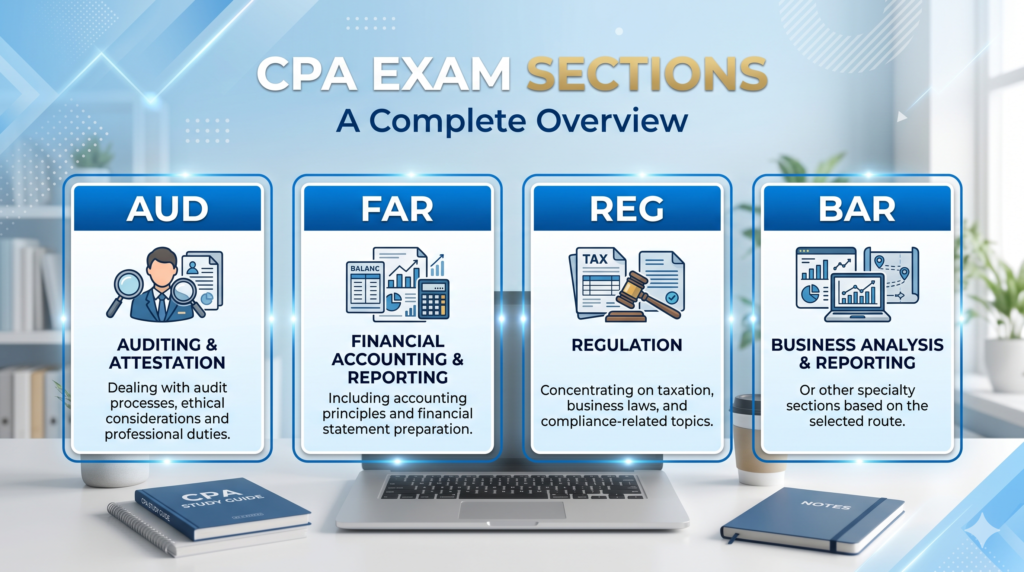
- AUD – Auditing & Attestation, dealing with audit processes, ethical considerations and professional duties.
- FAR – Financial Accounting & Reporting, including accounting principles and financial statement preparation.
- REG – Regulation, concentrating on taxation, business laws, and compliance-related topics.
- BAR – Business Analysis & Reporting or other speciality sections based on the selected route.
All sections need to be cleared within a set period to pass the certification process.
CPA Eligibility Requirements
Knowing What is CPA is important, but eligibility criteria also play a vital role in planning your certification journey effectively.
Common Eligibility Requirements
- Bachelor’s degree in commerce, accounting, finance or related fields from a recognised university.
- Fulfilment of certain credit hours in accounting and business topics as prescribed by U.S. state boards.
- Approved credential evaluation agencies for the evaluation of academic transcripts.
Each state board has different eligibility requirements so choosing the right state is important.
CPA Course Overview
This structure ensures that candidates gain comprehensive accounting and financial management expertise.
| Component | Details |
| Number of Exam Sections | Four sections |
| Exam Duration | Around four hours per section |
| Eligibility | Credit-based academic requirements |
| Recognition | Globally recognized professional license |
| Main Focus Areas | Accounting, audit, taxation, compliance |
Career Options Following CPA Certification
Certification through CPA opens many career options in various areas such as accounting, finance, consultation, and corporate management.
Common career positions include the following:
- Auditor – Involves assessing the finances and making sure that the accounting rules are adhered to.
- Tax Consultant – Assists individuals and organisations with taxes and regulations.
- Financial Analyst – Examines financial information to help plan for businesses and investments.
- Risk and Compliance Manager – In charge of an organisation’s implementation of financial laws and internal controls.
- Corporate Accountant – deals with the money (including the budgets) in multinational companies.
Salary increases, employment security, and international job movement are among the many career benefits available.
Advantages of CPA Certification
Obtaining your CPA certification can provide a competitive advantage in the financial market.
Main Benefits
- Global recognition and credibility, thereby making the professionals attractive to multinational employers and international firms.
- Higher salary and rapid career growth in Finance, Accounting and Consulting sectors.
- Exposure to international financial reporting standards and advanced accounting practices.
- More chances to take on leadership and management positions in organisations.
Such benefits make the qualification very valuable for long term professional development.
Why CPA Remains Relevant in 2026
As businesses become more globalised and regulations continue to evolve, there continues to be strong demand for qualified accounting professionals. Understanding What is CPA helps candidates understand why this credential still has a lot of value in international markets.
Candidates with a CPA are very attractive, as companies are looking more and more for people who understand international accounting standards, risk management, taxation and compliance processes.
Conclusion
By now, the answer to What is CPA should be much clearer for students and professionals looking at this career path in 2026. It gives you technical expertise, worldwide recognition and great career growth potential in a number of industries.
The CPA certification is still one of the most respected credentials in the world of finance and accounting professions, with a structured exam process, strong industry demand and excellent long term benefits.
FAQs on ‘What is CPA?’
What is CPA?
A Certified Public Accountant (CPA) is a globally recognised, premier accounting designation awarded by the AICPA.
What is CPA and eligibility?
CPA eligibility generally requires a bachelor’s degree, 120–150 semester hours of education
Is CPA better than CA?
Neither designation is universally “better”; the right choice depends on your goals and career.